Scaling P2P: Are you building a program or maintaining one?
Jesper Juul Jensen
CEO
9
Min to read
Two fundraising directors. Same budget. Opposite problems.
Director A runs a well-established charity run that's been going for eight years. Participation is steady, processes are solid, and the event runs like clockwork. But revenue has flatlined. Every suggestion for change gets buried in risk assessments and stakeholder consultations. Staff have stopped proposing new ideas because they know the answer will be "let's think about that for next year."
Director B leads a newer organisation that launches P2P campaigns constantly. Energy is high, ideas flow freely, and there's always something new in the pipeline. But nothing scales. Every event feels like starting from scratch. When a key staff member left last year, three months of institutional knowledge walked out the door with them.
Both directors are stuck. And both are stuck for the same underlying reason: a mismatch between the mindset their organisation operates with and the mindset their situation actually requires.
After more than ten years of working with charities on their P2P programs, I've started to see this pattern repeat. The specific circumstances vary, but the underlying dynamic is remarkably consistent. Organisations get stuck not because they lack resources or ideas, but because they're applying the wrong mental model to their situation.
Two mindsets, two failure modes
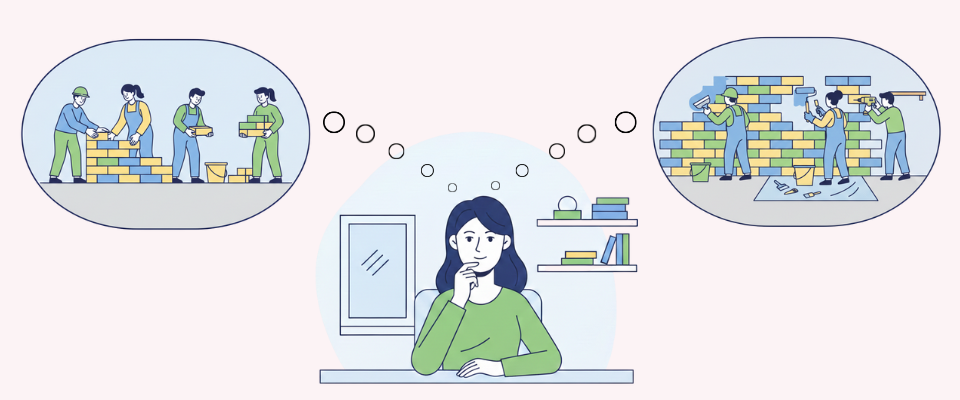
There are fundamentally two ways to approach a P2P program. I'll call them the builder's mindset and the inheritor's mindset. Neither is better than the other—but applying the wrong one to your situation will reliably produce disappointing results.
The builder's mindset is characterised by experimentation, speed over perfection, and a genuine appetite for risk. Builders ask "what if?" and "why not?" They're comfortable with imperfection because they know that launching something imperfect teaches you more than planning something perfect. They accept that some initiatives will fail, and they view failure as tuition rather than disaster.
Builders thrive when creating something new: a first P2P program, a new campaign format, an expansion into a new market. They also thrive when transforming something existing—and this is where organisations often get confused.
The inheritor's mindset is characterised by optimisation, consistency, and process improvement. Inheritors ask "how can we do this better?" and "what did we learn last time?" They're comfortable with incrementalism because they know that small improvements compound over time. They document, they systematise, and they build institutional memory.
Inheritors thrive when scaling what works: running the fifth edition of a successful event, onboarding new staff into established processes, squeezing more efficiency from proven campaigns.
The failure modes are mirror images. Builders without inheritor discipline create exciting chaos—things work, but they're fragile, undocumented, and dependent on specific individuals. Inheritors without builder energy create optimised stagnation—things run smoothly, but nothing new happens, and the organisation slowly falls behind.
The mismatch that costs you 3x your potential
Here's where it gets interesting. When an organisation wants to add P2P fundraising to an existing event, which mindset do they typically apply?
The inheritor's mindset. And that's exactly wrong.
Consider this real example. A charity had an established running event as part of their annual campaign. Revenue came purely from entrance fees—a predictable model they'd refined over several years. Leadership decided to add P2P fundraising to the event, recognising the potential to significantly increase income.
But they were cautious. The event had loyal repeat participants, and there was legitimate concern about scaring them off with changes. So they made P2P voluntary. Opt-in rather than opt-out. Participants could fundraise if they wanted to, but there was no expectation, no default, no real push.
The result? Almost no uptake. The P2P component was quietly abandoned the following year.
The potential upside had been substantial—comparable events that fully embrace P2P typically generate two to three times the income of entrance-fee-only models. But by applying inheritor caution to what was actually a builder challenge, the organisation got the worst of both worlds: the disruption of trying something new without the commitment required to make it work.
Adding P2P to an existing event fundamentally changes the proposition. You can't hedge your way into it. You need builder-level risk appetite even though you're working with something inherited.
The initiative that died in planning
The opposite mismatch is equally costly. Another organisation—one that hadn't launched anything new in P2P for several years—was approached by an external partner with an idea for a stair run event. The concept was solid, the partner was enthusiastic, and there was genuine potential.
The organisation responded with their well-developed inheritor processes: detailed planning documents, stakeholder alignment meetings, risk assessments, budget reviews. Months of meetings followed. The event never launched.
The problem wasn't the idea. The problem was applying inheritor process to a builder challenge. New programs—especially those initiated by external partners—need internal champions with builder energy. People who can make decisions quickly, accept imperfection, and maintain momentum. Without that, promising ideas die in planning while everyone waits for consensus that never arrives.
External partners often lose interest during extended planning processes. And by the time the organisation is ready to move forward, the window has closed.
Diagnosing where you are
Before you can apply the right mindset, you need to know where your program currently sits. Three questions help clarify this:
First, is your P2P revenue growing, flat, or declining? Growth suggests your current approach has momentum worth systematising. Flatness or decline suggests you need to try something different.
Second, when did you last launch something genuinely new? Not a refinement of an existing event, but something your organisation had never done before. If the answer is "more than two years ago," you're probably over-indexed on inheritor thinking.
Third, could a new staff member run your biggest P2P event from documentation alone? If yes, you have inheritor discipline. If no—if the event lives primarily in one person's head—you're operating in builder mode whether you intend to or not.
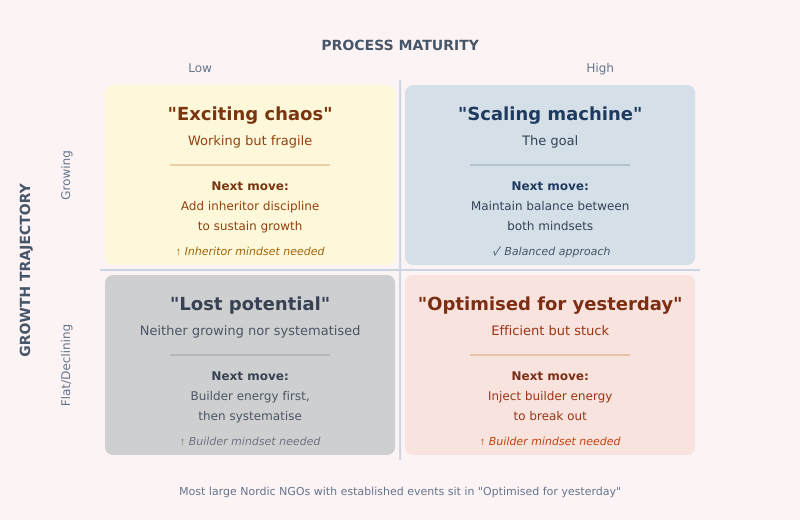
These questions map onto a simple framework with four quadrants, defined by whether you're growing or stagnant, and whether your processes are mature or ad hoc.
If you're growing with low process maturity, you're in "exciting chaos"—things are working, but fragile. Your next move is to add inheritor discipline: document what's working, build systems that don't depend on specific individuals, create playbooks that let you repeat your successes.
If you're growing with high process maturity, you've reached the goal—a genuine scaling machine. Your job is to maintain balance between builder experimentation and inheritor optimisation, neither letting process calcify nor letting innovation destabilise what works.
If you're flat or declining with high process maturity, you're "optimised for yesterday"—running efficiently but going nowhere. This is where most large Nordic organisations with established events find themselves. Your next move is to inject builder energy: give yourself permission to experiment, accept that some experiments will fail, and stop requiring certainty before trying anything new.
If you're flat or declining with low process maturity, you're in "lost potential"—the hardest quadrant to escape. You need builder energy first (to find something that works) and then inheritor discipline (to make it sustainable). Organisations that tried P2P half-heartedly and abandoned it often land here.
The counterintuitive insight is this: inheritors often think they need more process to fix stagnation. They don't—they need permission to experiment. Builders often think they need more freedom to achieve scale. They don't—they need documentation so their successes can repeat.
Shifting mindsets deliberately
Mindsets can be changed, but it requires conscious effort. Organisations don't drift from inheritor to builder by accident.
If you're in an established organisation that needs more builder energy, start by acknowledging that transformation requires risk appetite. You cannot add P2P to an existing event without changing the participant experience. If you make P2P opt-in "to be safe," you're not really trying it—you're creating a face-saving way to conclude that it doesn't work.
Ask yourself: what would we do if this were a brand new event with no history to protect? That question often reveals how much your thinking is constrained by legacy considerations that matter less than you assume.
Create protected experiments with genuine stakes. A pilot designed to fail quietly doesn't teach you much. If you're not prepared for the pilot to succeed and become permanent, it's worth asking whether you're really testing the idea or just going through the motions.
External perspectives can help shake inheritor thinking loose, but only if your internal team has authority to act on what they learn. Bringing in consultants or attending conferences accomplishes nothing if every insight has to survive a six-month approval process.
If you're in a newer organisation that needs more inheritor discipline, the key is documentation. Document as you build, not after. The worst time to write a process document is six months after the event, when you've forgotten half the details and the person who knew the other half has left.
Define "good enough" early. Builder energy can become an excuse for never finishing anything—there's always one more feature to add, one more iteration to try. Decide in advance what success looks like for this version, and stop when you reach it.
Build handoff capability from day one. Ask yourself whether a new team member could run the event from your documentation alone. If the answer is no, that's a vulnerability worth addressing sooner rather than later.
The Nordic context
P2P fundraising in Scandinavia is growing at roughly 50% year-on-year. That's a remarkable growth rate, and it tells us something important about where the market is in its maturity curve.
Volume still lags significantly behind Anglo-Saxon countries—the UK, US, and Australia have much more developed P2P sectors. But the growth rate suggests we're in an early expansion phase, not a mature optimisation phase.
What does this mean for the builder-versus-inheritor question? It means that for most Nordic organisations, the risk of moving too slowly is greater than the risk of moving too fast. In a rapidly growing market, the organisations that build capability now will have inheritor advantages later—established programs, institutional knowledge, proven playbooks. Those that wait, optimise prematurely, or approach new opportunities with excessive caution will find themselves playing catch-up.
This doesn't mean inheritor thinking is wrong. It means it's often premature. The time to optimise is after you've built something worth optimising.
The question to take away
The goal isn't to be a builder or an inheritor. It's to know which mindset you need right now, for this specific challenge, at this stage of your program's development.
Transforming an inherited program requires builder courage, not inheritor caution. Building a new program requires inheritor discipline before you think you need it. And operating in a market growing 50% annually means the cost of excessive caution is higher than the cost of imperfect experimentation.
So here's the question: what would you do differently if you approached your biggest current challenge with the opposite mindset?
If you've been optimising, what would you try if you gave yourself permission to experiment?
If you've been experimenting, what would you document if you admitted this needs to outlast you?
.png)