Team captains do the recruitment your charity can't
Jesper Juul Jensen
CEO
7
Min to read
Most charities think of teams as a competition feature. Something for sport events. Something with leaderboards.
That framing leaves a lot of money on the table.
The real reason to set up teams is recruitment. Teams are the cheapest way to grow your fundraiser base, because every team captain brings in fundraisers you would never have reached on your own.
This is one of those things that's been hiding in plain sight in the P2P data for years.
That's not a small effect. That's almost everything.
But it's worth being careful about what the number actually means. Read it as a recruitment story. When teams form, more people participate. When teams don't form, you only get the fundraisers that your own charity managed to recruit directly. There is no good evidence — ours or the wider industry's, as far as we can tell — that team fundraisers individually raise more than solo ones. The 93 cents is large because there are simply more fundraisers contributing to the totals.
This matches what we see in our own data on BetterNow. Campaigns that enable teams end up with substantially more fundraisers than campaigns that don't — same charity, same audience, same time of year. The team campaigns simply have more fundraisers in them.
How team captains extend your reach
A charity recruits from the supporters it already knows about. The list it has built up over years.
A team captain works from a completely different list — their friends, their colleagues, their gym, their kid's school, their book club. The two lists barely overlap, which is the entire point. Captains take your campaign into networks the charity simply doesn't have access to, and probably never will.
Then there's who is making the ask. A personal request from a friend to fundraise alongside them lands very differently than the same request coming from an organisation, even one the recipient already supports. Same content, different sender, completely different response.
And there's the obvious thing: most people don't want to fundraise alone. Joining a team makes the whole thing feel like something you're doing alongside other people. That lowers the barrier to signing up, and it keeps people committed in the bits where fundraising gets awkward (which is most of it).
None of this is deep insight. It's how social networks work. The useful way to think about it is that captains and the charity each handle a part of the recruitment job the other can't do well. The charity reaches its existing supporters, some of whom become captains. The captains then reach a much wider pool of friends and colleagues, who become fundraisers. The two sides of that work fit together.
The recruitment maths
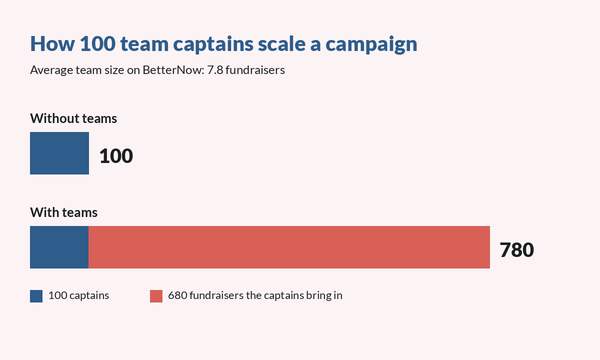
The same industry study puts the average team size at somewhere around five to eight members. On BetterNow we sit at the top of that range. Average team size on our platform is 7.8 fundraisers.
Average team size is 7,8 members - for the calculation we exclude teams with zero fundraisers from that figure, since those are almost always test pages or abandoned setups — you can't donate directly to a team on BetterNow without any members in it, so a team of zero is functionally not a team.
So every team captain you sign up brings in, very roughly, six or seven other fundraisers along with them. That's free leverage, assuming you already got the captain.
Sign up 100 captains and you end up with close to 780 fundraisers in your campaign — 100 captains plus the 680 or so others they bring along. Run a campaign without teams and those 100 captains are 100 fundraisers, full stop. The 680 extra people never get recruited at all.
You can be more careful with the math, of course. Not all teams fill up. Some captains build huge teams; some build a team of one. Some team members will sign up but never raise a krone. But the underlying logic is sound, and the data backs it up: teams produce more fundraisers per recruitment effort than any other channel a charity has access to.
Who actually makes a good team captain
Here's the slightly counter-intuitive part. Best captains are best recruiters — people with broad, active networks and a willingness to ask. That tends to be a different group of people from your top individual fundraisers from last year. The two qualities don't always overlap with "raised the most money".
A first-year fundraiser who works at a 200-person tech company and has the social skills to rally colleagues will out-recruit a five-year veteran who runs a quiet fundraiser every year and tops the individual leaderboard. The maths is just different.
So look for captains in different places. Returning donors who keep coming back. Board members. Volunteers with strong personal stories. Beneficiaries who are willing to share theirs. Corporate champions who can rally a workplace. Active members of local communities and parent groups.
The question to optimise for: who would five other people show up for?
How to set captains up to recruit
If teams produce most of the revenue, and recruitment is the actual mechanism behind that, then your job is to remove as much friction as possible between a captain and the next person they're going to invite.
A few specifics.
The recruitment moment has to happen inside the platform. As soon as someone creates a team, the next thing they should be doing is inviting their first batch of people. Not later. Not from their email client a week from now. Right then, with a one-click flow, while the motivation is still fresh. This is exactly why we have made it easy for team leaders to send invitations directly from their team page on BetterNow - the moment a team is created, the captain is already in the invite flow, with no extra steps.
The invitation copy should be pre-written. Captains shouldn't have to draft anything. They should be able to add a personal sentence if they want, and send. Asking captains to write the email themselves loses most of them at that step.
New team members need to be onboarded straight away. The moment someone accepts an invitation, they should land somewhere where the next step is obvious. Set up your page, write your reason, share it. If they hit a confusing dashboard or an empty page, they go silent. They almost always go silent.
Recognition should reward the recruitment work too. A captain who built a team of 12 has probably done more for your campaign than a soloist who raised more individually. That should show up in how you communicate and how you steward.
Common mistakes
A few patterns we see again and again.
Treating teams as event-only. They aren't. Teams work on most peer-to-peer campaigns, including ones that have nothing to do with sport. Birthday fundraising programmes, in-memory campaigns, ambassador campaigns - all of them benefit from teams. If your campaign has individual fundraisers, it can have teams.
Forgetting about schools. Schools are one of the clearest fits for team fundraising and one of the most consistently overlooked. Classes, year groups, sports teams, music ensembles - these are already team structures. Parents come in as captains, the social pressure to participate is already there, and the network is dense and high-trust. A school campaign without teams is leaving the most obvious recruitment mechanism on the table.
Hiding team setup behind admin. The longer it takes for a supporter to spin up a team, the fewer teams you will get. Most teams form on impulse, in the same session as the original signup. If creating one requires anything beyond a few clicks - or worse, requires the charity to enable it - half of them die before they start.
Letting captains figure recruitment out alone. They won't, mostly. They'll say they will, and then nothing happens. Pre-writing the invite copy and putting the invitation flow inside the platform is the difference between a captain who recruits and a captain who quietly does nothing.
Optimising only for top individual fundraisers. Covered above, but worth repeating.
Treating invitations as a one-shot. Captains should be able to come back and invite again, days or weeks later, when they've thought of someone they forgot the first time. If the flow only exists in the moments right after team creation, you'll lose all the second-round invites.
Where teams really earn their keep
A few situations where the lift is bigger than usual.
Workplace and corporate teams. The network is already formed. People work in the same office, chat in the same Slack channel, eat lunch in the same canteen. You've already solved the hardest bit of recruitment, which is figuring out who to ask in the first place.
Community-rooted causes. When the cause is the network - alumni groups, faith communities, parent associations - teams essentially form themselves. Your job is to stay out of their way and make it as easy as possible.
Multi-week campaigns. Teams compound over time. A week-long campaign barely gives a team time to form. A six-week campaign gives captains room to recruit, then re-recruit when the first round of asks runs out.
Niche causes. For mental health, addiction recovery, rare diseases - anywhere the supporter community is small and tight-knit - teams do something extra. They normalise the cause. People who would never start a fundraiser themselves will happily join one if their friend started it.
Closing thought
Teams are the cheapest fundraiser acquisition channel a charity has access to. And definitly cheaper than ads.
The actual job is to remove every bit of friction between a willing team leader and the next person they would invite. And then to keep doing that, every campaign, until it becomes invisible.
Charities that get this right will see teams become, quite possible, the back-bone of their recruitment for most campaigns.
.png)