Charity insights: Why donors donate to peer-to-peer fundraisers
Jesper Juul Jensen
CEO
8
Min to read
When fundraisers talk about what makes people give, we often point to need, altruism, or social pressure. But a recent study suggests another driver is at work in peer-to-peer (P2P) fundraising: inspiration. Donors aren’t just reacting to appeals; they are moved by the example of others. Understanding how donor inspiration works could help charities design smarter campaigns, recruit better fundraisers, and increase giving.
This blog looks at new research on donor inspiration in P2P fundraising and breaks down what it means for practitioners.
What the study set out to test
The researchers, Hesse and Boenigk, wanted to define and measure “donor inspiration” and test whether it actually drives donations in P2P contexts. They based their framework on:
The motivational theory of role modelling: people are inspired when they see others (role models) taking meaningful action.
The psychological construct of inspiration: a two-step process of being “inspired by” a source and “inspired to” take action.
Applied to fundraising, the study proposed that donors might be inspired either by:
the peer fundraiser,
the cause itself,
or a combination of both.
The central question: does inspiration explain why people donate, and which source inspires most?
How the research was done
Instead of surveys, the team analysed real campaign data from Workout for Water, a global P2P campaign run by Les Mills and UNICEF between 2019–2021.
Data set: 8,697 donation transactions.
Source of data: scraped directly from the campaign platform.
Inspiration coding: 3,494 donations included a written donor comment. These were manually coded to determine what inspired the donation (fundraiser, cause, or both) and how strongly (low, medium, high intensity).
Validation: cross-checking was done with automated sentiment analysis, but manual coding proved more accurate.
Controls: donor sex, currency zone, and fundraiser reputation (e.g. global representatives vs regular instructors).
This approach gave behavioural data, not just stated intentions — a major step forward in grounding fundraising insights in actual donor behaviour.
What they found
Several clear patterns emerged:
Fundraisers inspire more than causes
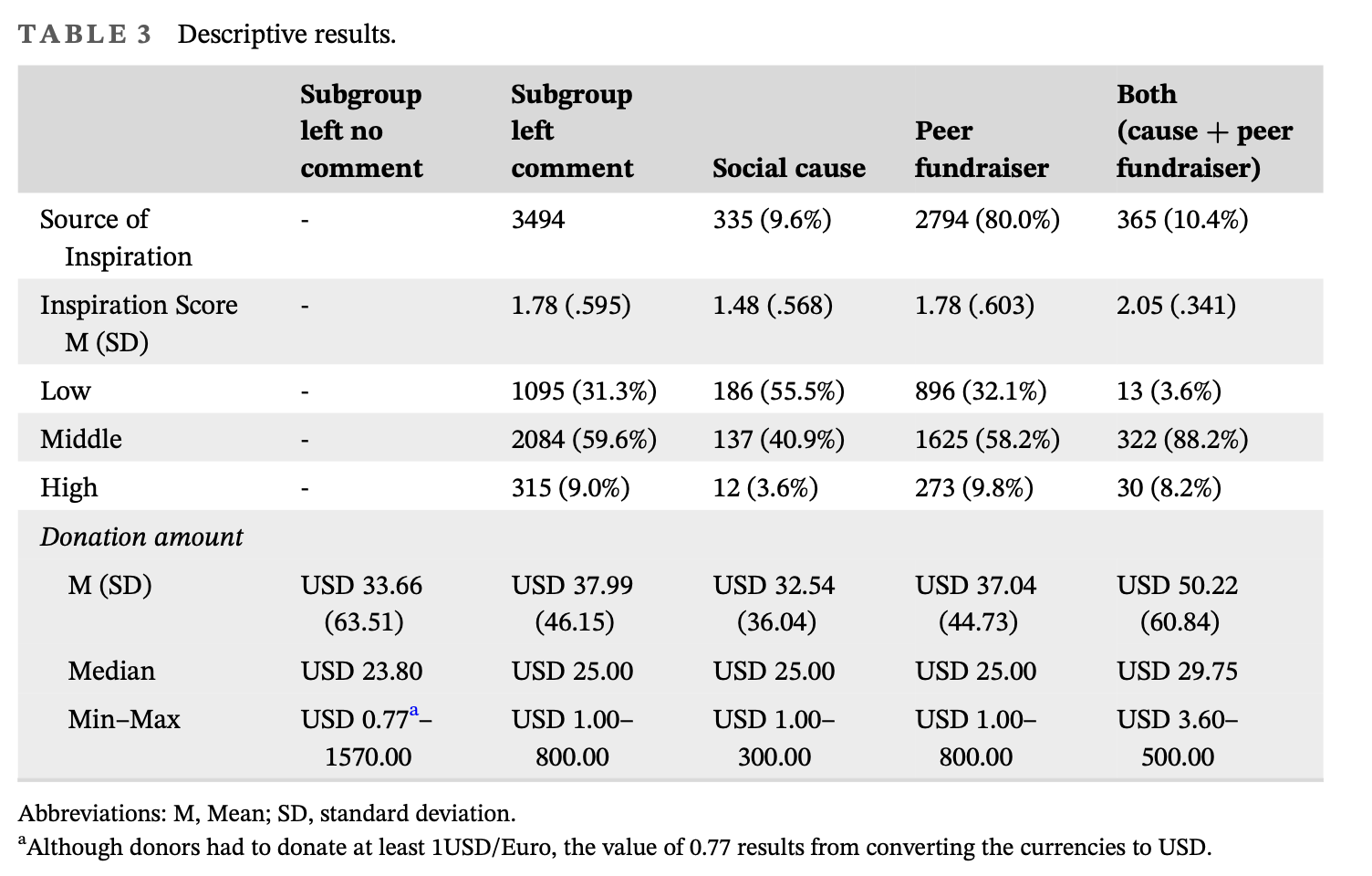
80% of donor comments mentioned the peer fundraiser as the source of inspiration.
Only 10% mentioned the cause alone.
When both fundraiser and cause were cited, donations were significantly higher.
Intensity of inspiration matters
Most comments showed medium inspiration, but the small share coded as high corresponded with higher average gifts.
Stronger inspiration predicted both the likelihood of donating and the amount donated.
Inspiration drives giving
Statistical tests confirmed that inspiration is positively linked to donation behaviour.
The “inspired-to” process (feeling compelled to act) mediated between being inspired by someone and actually giving.
Reputation of fundraisers counts
Donors gave more when the fundraiser was seen as a “champion” (e.g. global representatives or national trainers).
Peer connections outweigh altruism
The study reinforces earlier findings that in P2P giving, donors are motivated less by abstract causes and more by relational altruism — supporting a friend, colleague, or admired figure.
It’s worth noting that the same authors have also published a companion study using this very campaign data, but from a different angle: instead of focusing on donors, it looked at the fundraisers themselves. That research found that the most successful fundraisers were those who took extra actions, personalised their fundraising pages, and signalled commitment (for example through self-donations).
Taken together, the two studies underline a simple but powerful truth — inspiration flows both ways: fundraisers inspire donors, and the effort fundraisers put in makes that inspiration more likely to take hold.
Table 3 shows the average gift: $32.54 (cause only), $37.04 (fundraiser), and $50.22 (both).
What this means for fundraisers
The practical implications are clear and actionable:
Invest in inspirational fundraisers Recruit and highlight fundraisers who can act as role models in their networks. Their presence is more effective than the cause alone.
Pair fundraisers with the cause While fundraisers are the main driver, the biggest impact comes when both fundraiser and cause are highlighted together. Campaign materials should always connect the individual story to the larger mission.
Showcase fundraiser reputation and credibility Positioning “champions” in your community visibly can boost inspiration. Think about instructors, influencers, or respected figures who can inspire beyond their immediate circle.
Amplify inspiration on social media Social platforms allow inspiration to spread. Donors themselves can become inspirational sources if they share their giving publicly, triggering ripple effects.
Measure donor comments If your platform allows comments, don’t ignore them. They can be analysed to see what’s inspiring donors in real time, offering feedback on campaign design.
Why this matters
This study makes a strong case that donor inspiration is a distinct mechanism of giving, not just a by-product of need or solicitation. For charities, the lesson is that campaigns should be designed not just to inform or ask, but to inspire.
By understanding the sources and intensity of inspiration, fundraisers can intentionally craft campaigns that spark both admiration and action — moving donors from “inspired by” to “inspired to.”
Final thoughts
Donor inspiration is more than a nice side-effect; it’s a measurable driver of P2P giving. The challenge for charities is to build campaigns that make space for inspiration to happen and then amplify it. Fundraisers are central to this process — not just as collectors of donations, but as role models who bring causes to life.
The full study, Donor inspiration in nonprofit management: conceptualization and measurement in a peer-to-peer context by Laura Hesse and Silke Boenigk, offers detailed methodology and statistical evidence for these findings.
- - - -
This post is part of our ongoing series bridging academia with practical fundraising experiences. See all the posts here.
.png)


.png)