You're comparing event registration tools, and every list you find compares the same things: form builders, ticket types, check-in apps, pricing per registration. All useful. And all of it misses the question that decides how much your event raises.
For a company conference, the ticket is the end of the transaction. For a nonprofit, the ticket is the beginning of a relationship. The person signing up for your charity run can become a fundraiser, a donor, and a supporter you keep for years. Whether that happens is decided, to a surprising degree, by the software behind the signup form.
The numbers behind that claim
Blackbaud's peer-to-peer study of US programmes found that in runs and walks with a registration fee, 79.9% of participants never raise anything. Without a fee, 66.1% never do. Call it 8 out of 10. In the UK, the Mass Participation Pulse survey found that only 23% of mass-event participants fundraised at their last event.
The same Blackbaud data shows what the exceptions look like. Cycling events, where participants commit months ahead to a serious physical challenge, activate 71.5% of participants as fundraisers. Commitment before the start line changes everything.
And our own experience adds a floor to the scale: when fundraising is recruited by email after signup, as an opt-in, around 1% of participants end up with an active fundraising page.
1% to 71.5% is an enormous range for what is nominally the same activity. The gap comes from when and how participants are invited to fundraise. That is a software question.
Why the signup moment decides it
A supporter's motivation peaks in the moment they commit. They've chosen your event, they're picturing themselves on the course, and for the next thirty seconds you have their full attention. There's a date, an activity their friends can sponsor, and an identity taking shape: "I'm running for this cause."
An email three days later meets a different person. The excitement has settled, the inbox is full, and the invitation to "set up your fundraising page" is one more task. That's the 1%.
So the single most important thing to look for in event registration software for nonprofits is this: can the fundraising page be created inside the registration flow itself, pre-filled and ready, so the participant opts out rather than in? This is THE crucial feature to look for. If this isn't checked off, go look at other solutions and compare those instead.
What to look for: seven requirements
Okay, but other things matter too, of course. Here are the seven key features to look for in event registration software for nonprofits.
1. Fundraising inside the flow, on an opt-out basis
The fundraising page should be part of signing up: created automatically, pre-filled with the participant's name, the event, a suggested goal and a starter story, with a clear way to decline. Participants who want to say no can say no. Everyone else becomes a fundraiser in the same moment they become a participant. In one of our Swedish pilots we have tested both directions, and switched an event series from opt-out to opt-in and back again based on the data.
2. Your brand, your domain, your data
Registration should live on your own pages, under your own domain, with your organisation collecting the consents. This matters for trust at the payment step, and it matters more afterwards: the registrant list, the donor data and the contact permissions belong in your systems, feeding your CRM.
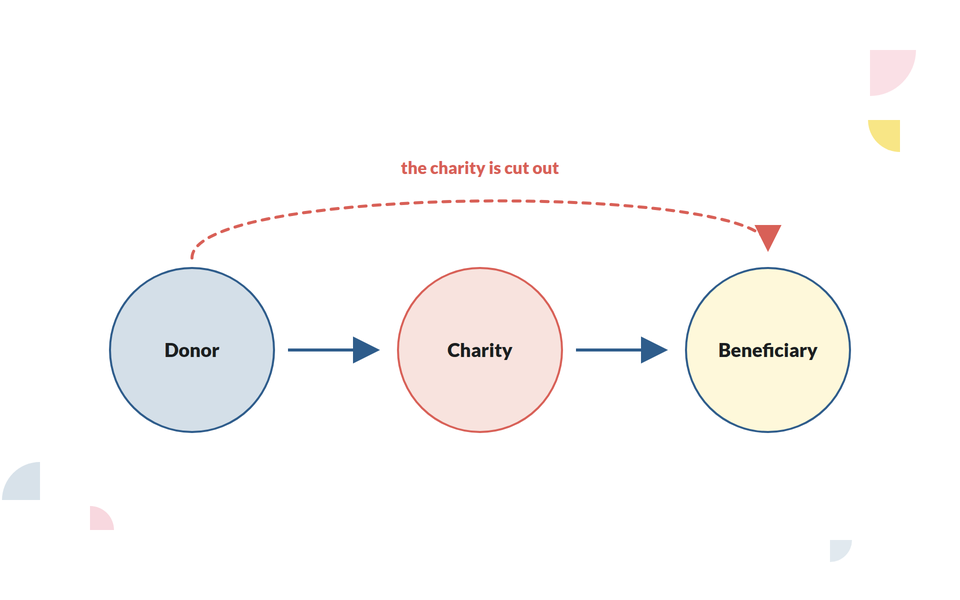
Giving increasingly flows through channels charities can't see (we've written about that shift and what to do about it in our piece on disintermediation). Your own event is one place you can keep the whole relationship.
3. The full ticket machinery
The fundraising layer only works if the ticketing layer needs no workarounds. Concretely, that means paid tickets, several participants in one order, discount codes, add-on donations at checkout, and bib number generation with print-at-home bibs. Every missing piece sends you back to a second system, and every hand-off between systems is a place where data and momentum leak.
4. Teams, captains and series in one structure
Most mass-participation events are social. Look for team pages with leaderboards, a special role for team captains (in our data the average team has 7.8 members, which makes every recruited captain worth roughly eight participants), and for event series: one shared front door, local admin rights per event, and reporting at every level. A national running series run from one spreadsheet and three tools is a familiar sight, and a fixable one.
5. Follow-up in the first 48 hours
Activation continues after signup. The system should trigger stewardship automatically: a welcome that celebrates the page, a nudge to make the first share, a prompt towards a self-donation (in our research, fundraisers who donate to their own page are 3.7 times more likely to reach their goal). The first two days after commitment are when this lands; a monthly newsletter cadence misses the window.
6. Reporting on the three numbers that decide the outcome
Dashboards love vanity totals. The three numbers to insist on seeing are the activation rate (what share of registrants have a live page with at least one donation), the average raised per active fundraiser, and the share of donors who are new to your organisation.
For context: US benchmarks put activation at 20–35% for runs and walks, and the UK Pulse found 48% of event fundraisers were first-time supporters of the charity. If the software can't show you these, it can't help you improve them.
7. Flexibility in where the fundraising sits
Should fundraising be centred on the team or on the individual? It depends on the event. A corporate relay raises best through team pages, where colleagues rally around one shared goal. A 5k with runners recruited one by one raises best through personal pages. And many events want both at once: personal pages that roll up into a team total, so the quiet fundraiser and the competitive team captain each get a page that fits them.
A great solution covers all three models and lets you choose per event, because the right answer varies between events, and sometimes between editions of the same one.
When simple ticketing is enough
Honest caveat: if your event has no fundraising ambition (a gala with a fixed ticket price, a members' meeting), a generic ticketing tool is cheaper and perfectly fine. Specialised registration software earns its keep when participants raising funds from their own networks is part of the plan. That's the case it's built for, and the case this guide is about.
The short version
Choose the tool that treats registration as the start of the relationship. One flow from ticket to live fundraising page, opt-out rather than opt-in, on your own domain, with the ticket machinery complete, teams and series in one structure, fundraising at individual or team level as each event demands, automatic follow-up, and reporting on activation, per-fundraiser results and new supporters.
That's the checklist we built BetterNow's event registration against, together with the two Swedish organisations piloting it this autumn. The first full results from those events are coming later this year, and we'll publish them here, activation rates included. The participants are already coming to your events. The software decides whether they leave as ticket holders or as fundraisers.