Disintermediation is one of those words that sounds like jargon and turns out to describe something you already recognise.
It means cutting out the middleman. Streaming services did it to record companies by connecting musicians straight to listeners. Booking sites did it to travel agents. In our sector it describes what happens when the charity gets cut out of the relationships it used to sit in the middle of: giving, asking for support, and providing help.
You'll notice we have some skin in this game. BetterNow sells white-label peer-to-peer fundraising software, which puts us inside this subject rather than outside it. There's a section near the end setting out exactly where we sit in the typology, caveats and all.
Here's what we'll cover: what the term means, the three forms it takes, how to tell a potential threat from a healthy change, why it happens at all, and what a charity can actually do about it. Most of it draws on Death by a thousand cuts, the 2026 white paper from Rogare and Kingston University Business School, which produced the first full typology of the phenomenon.
Start with the model being disrupted
What is a charity, structurally?
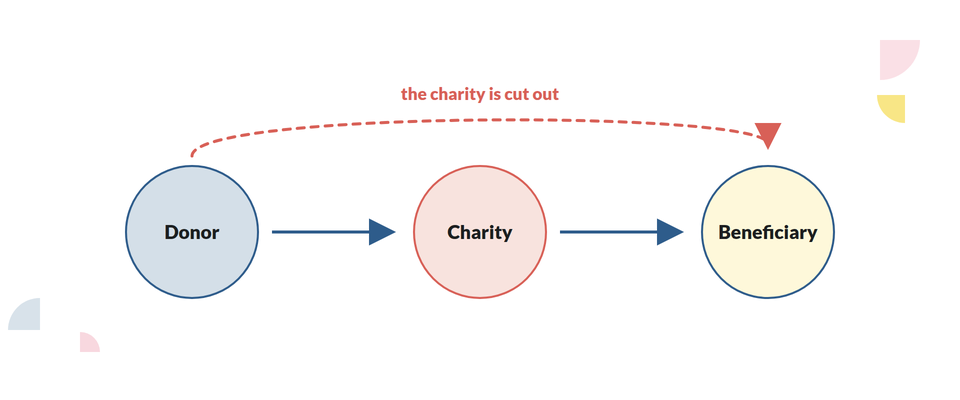
A donor gives funds to a charity. The charity turns those funds into products and services. A beneficiary receives them. The charity sits in the middle and mediates the whole thing. Rogare calls this the traditional charity model, and almost all of our sector's fundraising, regulation and professional practice is built around it.
Disintermediation is what happens when part of that chain routes around the organisation in the middle.
That can happen at three different points, which is why the research describes three types.
The three types
Type A: the charity is cut out of giving. Funds move from donor to beneficiary with a different entity in the middle, or with nobody in the middle at all. Someone crowdfunds a neighbour's medical costs. A mutual aid group hands out cash directly. A microloan platform connects a lender to an entrepreneur with no poverty relief charity anywhere in sight. The giving still happens. The charity has no part in it.
Type B: the charity is cut out of asking for support. This is the big one, with five subtypes. Citizen fundraisers running appeals on their own initiative. Commercial platforms fundraising in a charity's name. Philanthropy advisors, donor-advised funds and giving circles. What ties them together is that fundraising for the charity happens outside the charity's fundraising function.
Type C: the charity is cut out of delivering help. Companies, the state and alternative organisational forms take on service delivery that charities used to provide.
Nine subtypes sit underneath those three, with dozens of real-world variants beneath them. Which is to say the scope here is much wider than the crowdfunding conversation our sector usually has.
The distinction that matters most
Rogare separates three things that usually get treated as one:
- Displacement is when one intermediary replaces another. Somebody else steps into the role the charity used to hold.
- Decentralisation is distributing functions away from central control. A charity with 500 supporters running their own fundraising pages has decentralised its fundraising.
- Democratisation is opening participation up to more people. Anybody can now start a campaign for a cause they care about.
Only displacement is a problem. Decentralisation and democratisation are things most charities actively want, and peer-to-peer fundraising exists to produce both.
The paper mentions this: just because some form of displacement, decentralisation or democratisation has happened, that doesn't mean the charity has been disintermediated. Crowdfunding run under the auspices of a charity's fundraising function is decentralised and still entirely intermediated.
Treating supporter enthusiasm as a threat because it looks decentralised is the most common mistake in this whole area.
So where's the line? The outsourcing test
Charities have always handed parts of fundraising to other people. Direct mail agencies, telephone agencies, face-to-face teams. Nobody calls that disintermediation, because the charity still runs the show.
The researchers propose a spectrum rather than a binary, with one question to place any channel on it: who owns the donor relationship?
If the charity can build and keep that relationship, you're closer to outsourcing. If the external party controls it, disintermediation is happening.
In practice that comes down to three checks:
- Awareness. Do you know the fundraising is happening?
- Consent. Did you agree to it?
- Influence. Can you shape the donor experience, the messaging and the follow-up?
Two examples, to show how much the answer depends on how a thing is set up rather than what it's called.
In 2025 GoFundMe created 1.4 million donation pages for US nonprofits without asking them, or even telling them. Charities had no control over fundraising conducted in their name and under their brand. That fails all three checks. The platform reversed the policy after a backlash, and 23 state attorneys general followed up in writing.
Now compare that to in-memory giving. Somewhere between 50 and 90 per cent of UK funerals include a collection for a charity that mattered to the person who died, according to Legacy Foresight. Several tribute fund platforms withhold donor details, citing data protection, and one provider reports that almost all donors decline to have theirs passed on. The charity receives the funds and learns nothing about the people who gave.
That's a warm, entirely well-meant channel that still fails the influence test. Same question, very different answers, and in both cases the outcome turns on setup rather than category.
Why does any of this happen?
Technology enables disintermediation. It rarely causes it.
The cause is a gap between what donors want and what charities offer, and it shows up as four recurring demands:
- Transparency. Where exactly do my funds end up?
- Direction. I want to choose what my gift pays for.
- Engagement. I want to give as part of a community, with people I know.
- Trust. I'd rather rely on somebody I can see than an institution I can't.
Every one of those can be met inside a charity relationship. Where a charity meets them, supporters stay. Where the route in is slow, restrictive or invisible, supporters find a route that isn't.
Ceri Edwards, president of the European Fundraising Association, put it this way when the paper launched: the answer is to build better routes into a charity's mission, because if charities make engagement slow, difficult or controlling, people will go around them.
One honest caveat. Rogare is deliberately holding off on judging whether disintermediation is good or bad overall until a later phase of the research. Different forms of it will have different outcomes. The risk worth worrying about is beneficiary harm rather than sector market share: if displacing actors serve people in need less well than charities do, the people who lose are the ones already relying on the service.
What reintermediation looks like
Reintermediation is a charity reclaiming a position in a process it's been cut out of. Rogare is spending a whole phase on it, running through 2027 with the Chartered Institute of Fundraising, so the definitive answers aren't in yet.
Four things are already clear enough to act on.
Measure your own exposure. Most charities have never counted this. Take everyone who gave in memory, gave through a workplace scheme, or raised funds for you last year, and work out what share you could contact by name tomorrow. The gap between what you received and the number of people you can thank is your disintermediation, expressed as a number.
Offer the route in. Supporters who want to fundraise for you will do it somewhere. The only variable is whether that somewhere belongs to you. A visible, easy, well-supported way to fundraise on your own site keeps the activity decentralised and keeps you in control at the same time.
Fix what sends people away. Directed giving, clear reporting on where funds went, and something real for supporters to belong to. That's the four demands above, answered.
Then actually use it. Owning the data is a precondition for the relationship rather than the relationship itself. A charity that collects 400 fundraiser email addresses and contacts none of them has done the hard part and skipped the point.
Where a white-label provider like us sits
We have an unusual answer, because we used to be on the other side of it.
BetterNow started as a giving platform. Our own brand, our own site, supporters fundraising for charities through us. It grew into Scandinavia's largest giving platform in under two years, and it had a problem we eventually had to admit to: fundraisers wanted to be thanked by the charity rather than by us, and 80 per cent of our signups came through charity referrals anyway. We were, in our own description at the time, a very noisy middleman.
So we rewrote the entire product as white label in under six months and stepped our brand back out of the way. Charities who switched got 71 per cent more contact permissions, and their fundraisers raised 12 per cent more. We had no proper word for it then. Reading Rogare's paper a decade later, the word for what we did is reintermediation.
Here is more details on where what we did fit into the mode put forth by the researchers.
Type Bii covers commercial organisations that displace a charity's fundraising function, and the paper draws the line clearly: where charities can shape the experience, the data and the ask, the organisation is better understood as an outsourced supplier than a disintermediator. On the three checks, white label passes. The charity sees every fundraiser the moment it's created, the fundraising happens because the charity chose to offer it, and the pages, the brand, the emails, the donor data and the follow-up all belong to the charity.
Four caveats:
We're still an intermediary. Donations pass through our system, we hold data as a processor, and if we vanished tomorrow those pages would go with us. That's dependency rather than displacement, and it's a fair thing to weigh up about any supplier, us included.
Recruitment is the part software can't do for you. When a supporter sets up a fundraiser on a charity's own site off their own bat, Rogare would call that person a citizen fundraiser, and at least the charity has awareness and influence from the moment the page appears. Better still is the charity that goes out and asks people to fundraise in the first place. That's a fundraising discipline rather than a feature, we spend a lot of our time telling customers so, and it stays the clearest difference between charities that run a peer-to-peer programme and charities that own a peer-to-peer product.
Owning the data is a precondition, not a relationship. A charity can run everything on its own domain, collect every email address, and contact nobody. The infrastructure is the easy half. We watch charities get this right and get it wrong on identical software.
We have a commercial interest in this argument. We sell infrastructure, and this article says infrastructure matters. The measurement exercise above works no matter whose software you use, including none.
Where the research goes next
Phase 1, the typology, is published. Phase 2 looks at why donors and other actors choose to go direct, expected late in 2026. Phase 3 takes on the regulatory and ethical questions, with a discussion paper before the end of 2026. Phase 4 brings practitioners in to work out how charities reintermediate, running through 2027, with a toolkit expected in late 2027 or early 2028.
All of which is to say this conversation is just getting started. If it's your area, the white paper is free and well worth the time: Death by a thousand cuts.



.png)